This section provides an introduction to affordable housing terminology, development, and operations. If you are searching for a home to rent or purchase, please start with the program pages, where you’ll find information about HRB homes, the application process, and eligibility requirements.
Much the information provided here applies not just to HRB, but to all affordable housing providers. Many of our practices are determined by the government programs that fund our projects, and most affordable housing providers rely on the same programs. You’ll see that we, and our peer organizations, operate in a highly regulated environment.
What we can control is how we steward our homes and treat our residents and applicants. At HRB, we are proud of how we do both these things.
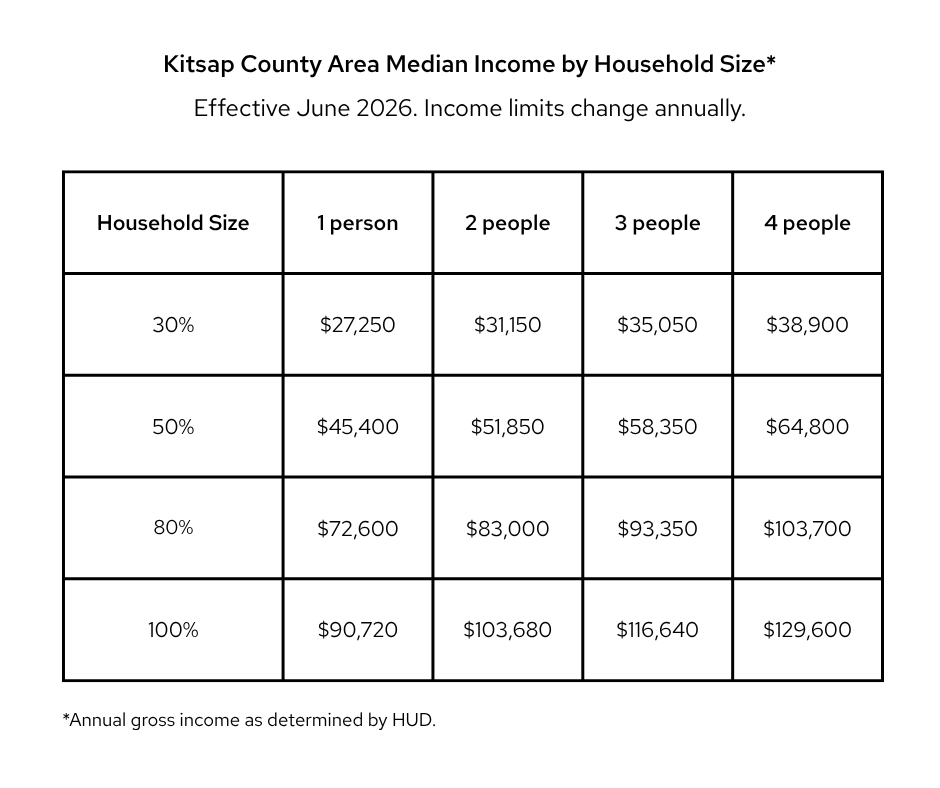
HRB and other affordable housing providers use the area median incomes determined by HUD. HUD begins by calculating the area median income for a family of four in a specific region (in our case, all of Kitsap County). It then adjusts this income according to family size using a special formula. These figures are used as income limits to determine eligibility for affordable housing.
If you visit the U.S. Census, you can find the median income for Bainbridge Island. This will be different than what appears here. It reflects Bainbridge Island only, does not account for family size, and uses different methodology for extracting data from the census.
Affordability is usually assessed as a percentage of income with conventional wisdom dictating that households pay no more than 30% of gross household income on rent and utilities. Though useful as a rough guide, the 30% rule has its limitations. Paying 30% of a $200,000 salary leaves plenty to cover basic needs such as food, transportation, and healthcare. Paying 30% of a $30,000 salary, however, will likely mean a struggle to make ends meet. The situation becomes even more nuanced when other factors are introduced, such as family size. A single person earning $30,000 will fare better than a mother with two children who earns the same salary but spends more on clothing, food, and medical bills.
Housing providers are often more flexible when determining income eligibility. In fact, HUD consider 30-42% affordable. For homeownership, HRB uses 35%, with the rationale that income will likely go up while housing costs remain the same, making the home increasingly affordable.
Affordable housing is priced by government funders to be affordable to people at certain income levels and is below market rate. The rent is fixed and does not change based on income. Tenants must pay the rent as it is charged. Most of what HRB offers is affordable housing; however, it has a small number of units with project-based vouchers (see “Subsidized housing and housing vouchers” below).
With subsidized housing, residents typically pay 30% of their gross household income toward rent, and the government pays the remainder. There are several different subsidized housing programs in the US. These are the most common:
- Project-based vouchers (PBVs) are tied to specific units of housing. These homes can be in a market-rate building or in a low-income building. Residents pay 30% of their household income toward rent and the government pays the difference between that payment and the HUD-determined fair market rent for the unit. When the resident moves, the subsidy stays behind and is used by the next tenant. PBVs allow HRB to house the lowest-earning households, often retirees and those with disabilities who rely on Social Security and people coming out of homelessness. HRB has 14 PBV units.
- Tenant-based vouchers help low-income renters afford housing in the private market or with an affordable housing provider like HRB. Participants can choose any home that meets the program’s health and safety requirements and pay 30% of their household income toward rent. When the resident moves, they take their voucher with them. Demand far exceeds the number of vouchers available, and waitlists are long. In Kitsap County, the waitlist is currently closed. HRB works with the Housing Choice Voucher Program, often referred to by its old name, the Section 8 Program (after Section 8 of the United States Housing Act of 1937, which created and authorized the program).
A community land trusts (CLT) are nonprofit organizations that conserve land for affordable housing, removing it from the profit-driven real estate market and using it for the long-term benefit of the community. They build or acquire homes and sell them to income-eligible households. But they never give up ownership of the land. Instead, they lease it to the homeowner for a 99-year term with the option to renew. Regulations in the ground lease—not market forces—dictate the sale price, ensuring that these homes remain affordable to future buyers while still allowing the seller to build equity. CLTs can also include rental homes, farmland, and business and community spaces.
Although our focus is permanently affordable housing, HRB advocates for a healthy housing ecosystem—housing of all shapes and sizes suitable for people in different stages of life and affordable to households across the income spectrum. We do this by supporting land use policy, zoning, and development regulations that support such a housing ecosystem.
Under the 1990 Growth Management Act (GMA), most Washington cities and towns are required to adopt and periodically update comprehensive plans to guide anticipated growth for a 20-year period. These planning documents address land use, housing, transportation, natural resources, climate change and resiliency, capital facilities, and more. In 2021, with the passage of House Bill 1220, municipalities are now required to plan for housing that is affordable to households at specific income brackets.
The Winslow Subarea plan covers similar concerns as a comprehensive plan but has a narrower geographic focus, specifically Winslow Way, Island Village, the public schools, and surrounding residential areas. Because Winslow is the site of higher-intensity residential and commercial use, it will play a pivotal role in helping the city satisfy the requirements of House Bill 1220 (see comprehensive plan above and the advocacy FAQ). Likewise, its update, currently underway, is intended to lead the way for the city’s Comprehensive Plan update. The final plan will reflect priorities and recommendations from the Sustainable Transportation Plan, the Housing Action Plan, and the Climate Action Plan, with additional land use and transportation policy recommendations in coordination with the 2026 update to the Comprehensive Plan. Learn more.
Density bonuses are one way to incentivize inclusionary zoning. They allow a developer to build more units than allowed by the zoning code in exchange for building affordable homes. This can be achieved by raising height allowance, increasing the number of units, or lowering parking requirements.
FAR is the ratio of a building’s total floor area to the size of the lot. Cities use FAR to regulate building size. For example, a maximum FAR of 1.0 on a 10,000 sf lot means that the site can support a building with two 5,000 sf floors, a building with four 2,500 sf floors, or any other building with floors that add up to 10,000 sf and comply with city limits on lot coverage and height. Unlike limits placed on units per acre, FAR does not control the number of dwelling units within a given building, creating an opportunity to build more but smaller homes.
The City of Bainbridge Island conceived the Housing Design Demonstration Project (HDDP) to increase the supply and choice of housing and to create housing that serves low-income households and uses innovative green building practices. Qualifying projects are granted incentives, such as density bonuses and reduced parking and setback requirements, in exchange for building affordably and sustainably.
Inclusionary zoning encourages or requires developers to include below-market units as part of market-rate developments. These policies can lead to affordable housing that is integrated in neighborhoods throughout the community. Inclusionary zoning programs often incentivize voluntary participation or compensate developers for required participation.
The multifamily tax exemption is used to encourage the development of affordable multifamily housing by granting a partial property tax exemption (for 8, 12, or 20 years in Washington). The exemption applies only to the portion of the development that is affordable.
On our work, there are two main types of subsidies:
- Financial assistance given to affordable housing providers to lower the cost of construction, acquisition, or rehabilitation.
- Rental assistance to help residents pay rent in the open market or in a regulated affordable home. See “subsidized housing and housing vouchers” above.
A program of the U.S. Treasury, LIHTC was created in 1986 to promote private sector investment in affordable rental housing. Since then, it has helped create over 3 million homes.
The federal government allocates federal tax credits to states based on population. Developers apply to the state for credits to help fund projects that must be affordable to some degree, comply with income limits, and be kept in good repair. A credit is worth 9% of eligible construction costs. A typical LIHTC project generates more tax credits than the developer will owe in taxes so they “sell” them to tax credit investors (typically banks and insurance companies) which have large federal tax liabilities. The investors pay up front, generating equity for the project and minimizing debt. Investors, in turn, claim the credits over ten years, beginning when the project is finished.
A transfer of development rights program allows developers to purchase development rights from “sending areas,” such as farms or critical habitat, for use in “receiving areas,” such as city centers or other areas designated for growth. The developer is allowed to build with greater density, and the landowner is compensated for the loss of development potential. A conservation easement is placed on the sending area, ensuring that the land is permanently protected.
Not to be confused with middle-income housing, this term has nothing to do with income and instead refers to the size and type of home. Middle housing falls between detached single-family homes and mid-rise apartment buildings. It includes duplexes (side by side or stacked), larger multifamily buildings, townhomes, and cottage courts and offers more potential for affordability than single-family housing. That said, you will often hear middle housing used colloquially to mean housing for middle-income earners.
HRB owns 73 rental units distributed across nine properties. We are also the nonprofit partner in 48 units at Island Terrace. There are 75 homes for ownership in our portfolio.
Our land trust is growing. In 2024 we purchased 13 units at the Oliver at the developer’s cost to build. The Ericksen Community, an 18-unit rental building on Ericksen Avenue, was completed July 2026. And in October 2026, HRB broke ground on 22 single-family homes at Finch Green.
HRB relies on government subsidy, notably grants from the Washington State Housing Trust Fund. We also depend on grants from private foundations and community philanthropy.
Our rental properties have long-term financing which is paid off from rental revenue over many years. Our homeownership properties are financed in part by income from home sales.
Community land trust homes make maximum use of land and funding and align housing prices with wages.
Here’s what happens when there are no resale restrictions: The individual homeowner sells at market rate, which on Bainbridge might mean considerable profit, maybe even enough to buy a home on the open market. However, only one household benefits from the initial public and private subsidy that went into creating an affordable home. The community has lost an affordable home, and more land and funding must be found to build a replacement.
Here’s what happens when there are no permanent rent restrictions: Government funding programs require a period of affordability. For example, the Washington State Housing Trust Fund, a primary funder for HRB, requires that funded rental projects remain affordable for a minimum of 40 years. With affordable housing programs that do not enforce permanent affordability, homes enter the open market after the period of required affordability ends. Again, the community loses an affordable home, and more land and funding must be found to replace it.
In both cases, given the rising cost of construction, the replacements will be more expensive to build. And land will likely be harder to come by. Permanent affordability maximizes the benefit of every acre developed and every dollar invested.
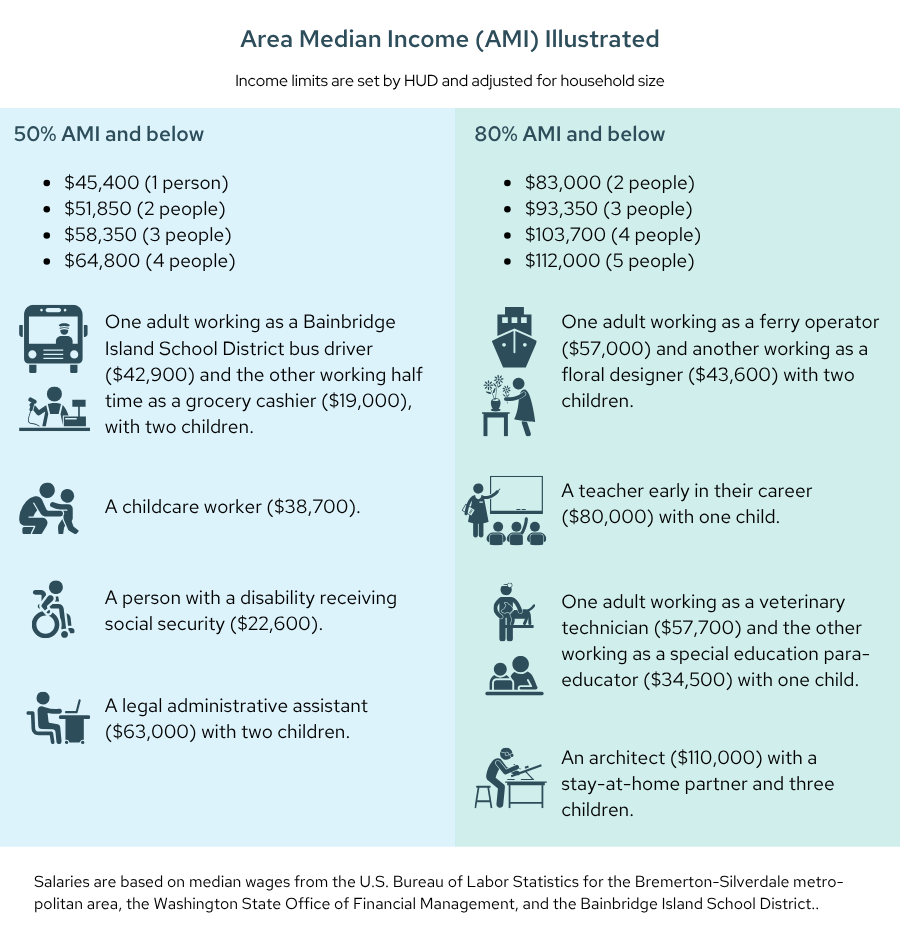
HRB serves primarily low-income households, which is defined as at or below 80% area median income (AMI). The exact income qualification for a specific unit depends on the requirements of the government program which funded its construction, acquisition, or rehabilitation.
Most of our homes for ownership are reserved for households earning 80% AMI and below, with about a dozen available to households earning 120% and below. Most of our rental homes are reserved for 50% AMI and below, with a small minority serving 60% and 80%.
The illustrations below should help you visualize these income limits and show you the work sectors represented by HRB residents.
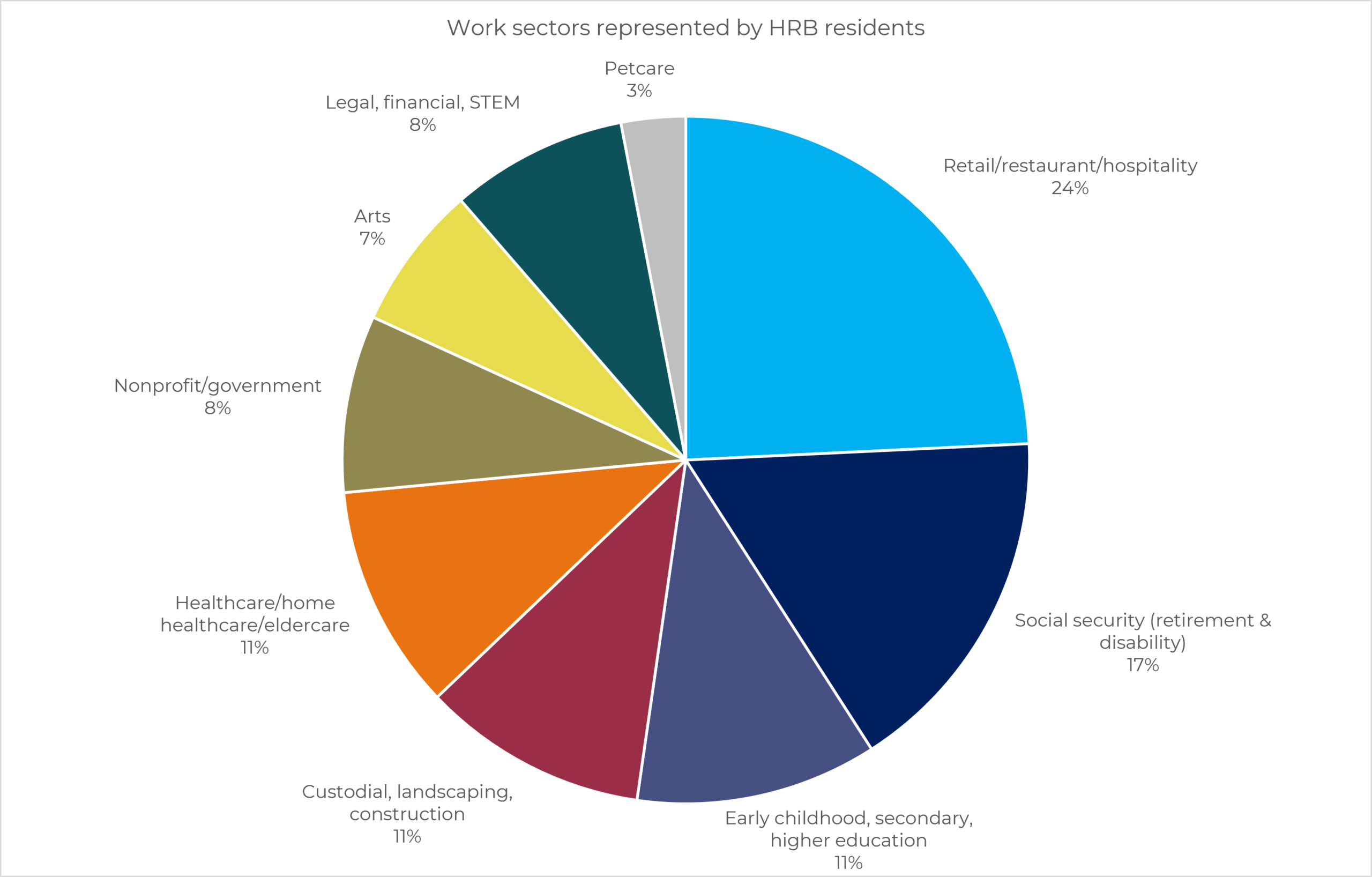
Note: HRB renters are income certified every year, which means their most current employment is reflected here. HRB homeowners, however, share their employment information at the time of purchase only.
The median sale price on Bainbridge is about $1.2 million, which requires an annual income of close to $300,000 and a down payment of $240,000. The average rent for a two-bedroom apartment is $2,600, which requires an income of about $104,000.
HRB is concerned about demographic changes that undermine the health of our community and can be attributed in part to the island’s high-priced real estate.
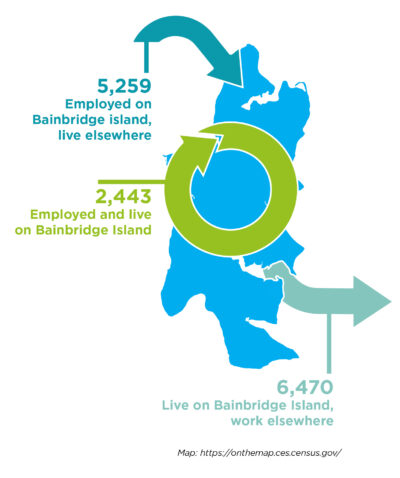
Two-thirds of the people who work on Bainbridge commute from off island. Not only do these workers face an unsustainable commute, but services on Bainbridge, be they eldercare or grocery stores, are vulnerable in the event of bad weather or an emergency.
The median age on Bainbridge Island is 52, compared to 41 in all of Kitsap County. From 2000 to 2020, the share of Bainbridge Island households with children declined from 49% to 35%. The percent changes was greater on Bainbridge than for both the county and state.
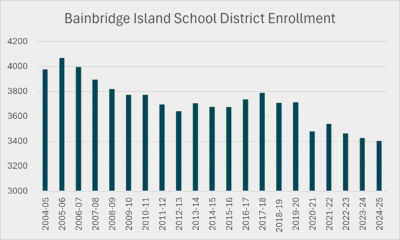
With fewer families, school enrollment is dropping.
HRB envisions most multifamily affordable housing in areas consistent with the guiding principles of the Bainbridge Island Comprehensive Plan, specifically the Winslow Town Center and other neighborhood centers, which are intended to accommodate growth. HRB would like to see both exclusively affordable development and units integrated into market-rate complexes (see HRB at the Oliver and Wintergreen). We also support scattered-site affordable homeownership elsewhere on the island in a manner that is consistent with zoning (see Lovgreen).
HRB works to prevent homelessness by providing below market-rate, long-term homes to low-income households. We do not provide transitional housing, nor do we provide social services to unhoused individuals. However, we often refer people experiencing homelessness to area social services.
HRB owns 121 rentals, which includes Island Terrace where we are the nonprofit partner in a 48-unit Low Income Housing Tax Credit property. HRB does not manage Island Terrace.
75, with over 30 more under construction or planned.
The cost of land, materials, and labor make building affordably a challenge. However, there are steps that the city can take to make developing affordable housing more viable. HRB advocates for policies that help bridge the gap between the cost to build and operate low-income housing and the revenue generated from renting or selling it, for example policies that allow greater density, flexible parking specifications, and fee forgiveness and increase the availability of city funding.
We recognize that nonprofits such as HRB cannot meet the demand for affordable housing alone and that private developers can be part of the solution. Therefore, we also seek policies that incentivize and maximize the number of affordable units within market-rate developments
Visit our Advocacy Alert archive to learn more about our public stands and legislative successes.
HRB remains a steady, harmonious, and effective voice for affordable housing on Bainbridge—in the community and at City Hall. We regularly offer public comment at City Council and Planning Commission meetings, serve as resident expert on housing issues, and convene community stakeholders around the need for affordable housing.
Read more about our advocacy strategy: To turn requirements into results, HRB advocates for all.
305. This figure does not include naturally occurring affordable housing, for example a cut-rate deal offered by a relative or a home in poor repair that could not command market-rate rent. When we talk about affordable housing, we mean regulated affordable housing that complies with income and rent requirements set by the government programs that helped fund its construction.
HRB is less common among community land trusts in offering opportunities for both homeownership and rental. Many subscribe to the American dream of homeownership, but homeownership is not right for everyone at every time in life. People across the income spectrum might opt to rent because of the inability or lack of desire to maintain a property, the necessity of frequent moves, the freedom to downsize, or because they cannot afford a down payment for a desirable home.
Different units have different income limits depending on the government program that funds its construction, acquisition, or rehab. These government funders use area median income (AMI) as calculated by HUD. See Key Terms for an explanation of AMI. HRB rentals without project-based vouchers serve these income ranges: 30-50%, 40-60% and 60-80% area median income. HRB homes for purchase service mostly 80% AMI and below.
HRB rents are decided by the government program that funded the construction, acquisition, or rehab of the home. Rents are set to be affordable to households at the income limit assigned to the unit. Most funders adhere to the HUD standard of affordability, meaning that residents pay 30-42% of their gross household income in housing costs, which include utilities. When rent does not include utilities, HUD estimates utility costs, and the landlord reduces the rent by this amount.
When multiple funders are involved (called a “capital stack”), each requiring different income limits, the rent complies with most stringent contract.
For example, HRB has a 2-bedroom unit that has two funders, one requiring tenants to be at 80% AMI or below and the other requiring that they be at 50% AMI or below. HRB must therefore set the rent to be affordable to households at 50% AMI. For 2026, the rent for a unit at 50% AMI is $1,458 a month. HRB pays for water sewer and garbage for this property, and tenants pay their own electric bills. The HUD calculation for the utility allowance for this unit is $138. After the utility allowance is deducted, the amount that the tenant pays for rent is $1,260 a month.
It is important to note that funders re-calculate rent amounts and HUD recalculates utility allowances annually. This means that rents typically go up each year.
In units that do not have a project-based voucher present and if the tenant does not have their own voucher, we have income minimums. We want to ensure that after rent is paid there is enough money remaining to cover food, healthcare, and other basics. Income minimums are intended to avoid a situation in which tenants make dangerous trade-offs in order to make rent.
The options are contract dependent. Some contracts allow residents to stay and pay 30% of their income toward rent, others require that they pay fair-market value, and still others require residents to leave. In the latter case, HRB typically issues a short-term lease to give residents time to find new housing. Sometimes households are able to transfer to another HRB unit in their income bracket.
Many affordable housing providers have waitlists for each property. HRB keeps a combined waitlist for all our properties, as well as a second list for people seeking a home with a project-based voucher. Applicants must have a household income at or below 80% AMI to be added to the primary waitlist and 50% AMI for the second one.
Different units are set aside for households in different income ranges and priced accordingly. Some units have additional criteria. One might be restricted to households with school-age children and another might prioritize those with mobility impairments. Therefore, applicants may not be eligible for every vacancy. Household size also affects eligibility. We would not place a single person in a three-bedroom home, for example.
When a unit becomes available, rental staff pull a list of eligible households based on income and household size, and if applicable, disability, and other eligibility criteria. It is an organizational policy and a contractual requirement that we prioritize households experiencing homelessness or fleeing domestic violence. So HRB will notify these households first, in the order of time on the waitlist, before moving on to the others, also in order of time on the waitlist.
Typically, there are between 250 and 300 households on the waitlist. Waitlist participants can be removed at their request (they may have found housing elsewhere), if changes in their income makes them ineligible, or if they do not respond to attempts to reach them.
Of our working households, about 85% work on Island. However, about a quarter of our rental households are senior and disabled residents who do not work.
75, with 35 more under construction, in predevelopment, or planned.
75. All the income-restricted affordable homes for ownership on the island are in the HRB community land trust. These homes are priced to be affordable to households earning 80% area median income (with a few reserved for households earning as much as 120%). There may be other, naturally occurring affordable homes for sale, perhaps due to poor condition or exceptionally small size. But with time, demand, or repairs, they will not stay affordable. The homes in the HRB community land trust are permanently affordable for income-eligible buyers.
Homes range from $180,000 – $350,000, depending on size and the year they were built.
To qualify, homebuyers must have a steady income that is at or below 80% area median income, with a minority of homes available to households at 120%. Total housing costs can be no more than 35% of gross monthly income, and total debt (including housing costs) should be no more
than 40% of gross monthly income. Total assets after closing are limited to $300,000, and a credit score of 640 or higher is required. Learn more.
HRB maintains one waitlist for our homeownership program. At any given time, there are typically 70 – 90 households on the list.
After an applicant is determined to be eligible for our program, they are added to a waitlist. To remain on the waitlist, applicants must update their income annually by submitting their most recent tax return. When homes become available, waitlist applicants are given the opportunity to apply based on how long they’ve been on the waitlist and their ability to secure affordable financing. Households with accessibility needs would be prioritized for ADA homes, and 3- and 4-bedroom homes would be prioritized for households of three or more.
Because individual circumstances change, an applicant who is newer to the waitlist may have an opportunity to move forward sooner than expected. We encourage anyone who may be interested in our program to apply.
In today’s construction environment, even a home priced at the cost to build is not affordable to our buyers. HRB secures government grants and private philanthropy to help fund construction or acquisition, lowering the price to buyers. Staff then work with buyers to arrange down payment assistance, typically a low-interest deferred loan, and a government-issued, low-interest mortgage designed for low-income buyers. A below-market price in combination with these products ensures that total monthly housing costs, including utilities, do not exceed 35% of gross income.
While it is true that community land trust homeowners cannot sell at market rate and therefore won’t make the outsize profit so many associate with real estate, they earn equity by paying down the mortgage principal and ultimately, by selling at a price that reflects a small percentage of appreciation. (HRB homeowners earn a maximum 1.5% annual return.) Equally important, mortgage payments are fixed and often become increasingly manageable, while rent only goes up.
Recently, an HRB home, appraised at $604,500, sold for $185,107. The price was affordable to the buyer, and the seller earned $62,000 in equity over eight years.
CLT homes are inheritable.
The cost of land, materials, and labor make building affordably a challenge. However, there are steps that the city can take to make developing affordable housing more viable. HRB advocates for policies that help bridge the gap between the cost to build and operate low-income housing and the revenue generated from renting or selling it, for example policies that allow greater density, flexible parking specifications, and fee forgiveness and increase the availability of city funding.
We recognize that nonprofits such as HRB cannot meet the demand for affordable housing alone and that private developers can be part of the solution. Therefore, we also seek policies that incentivize and maximize the number of affordable units within market-rate developments
Visit our Advocacy Alert archive to learn more about our public stands and legislative successes.
HRB remains a steady, harmonious, and effective voice for affordable housing on Bainbridge—in the community and at City Hall. We regularly offer public comment at City Council and Planning Commission meetings, serve as resident expert on housing issues, and convene community stakeholders around the need for affordable housing.
Read more about our advocacy strategy: To turn requirements into results, HRB advocates for all.
Denser housing is less expensive to build, as the cost of land is distributed over many units. It is almost impossible to build affordably any other way.
It is also the most environmentally sustainable way to build. Denser housing is less land intensive and is the perfect counterpart to conservation. Denser housing reduces suburban sprawl, requiring fewer new roads and wells, and consumes less animal habitat. And denser housing, specifically multifamily housing, is more energy efficient in heating and cooling. The environmental benefits only accrue when this housing is located near public transformation or within walking and/or biking distance of amenities.
Adopted in 2021, House Bill 1220 refines the housing element of the Growth Management Act (GMA) to address the state’s shortage of affordable housing. Previously, Washington cities and towns planning under the GMA were simply required to plan for housing that would accommodate anticipated population growth. HB 1220 requires that cities and towns be able to show that their development regulations would allow not only a certain number of homes, but a certain number of homes within a series of income bands. Learn more: Washington State directs Bainbridge Island to plan for growth.
Sign up for our mailing list. When an issue related to affordable housing is on the City Council or Planning Commission agenda, we send out an Advocacy Alert with a brief explanation and our perspective so that you too can speak up for housing. We’ll also let you know about upcoming HRB trainings and conversations about advocacy.
Write to City Council and Planning Commission and watch the meetings. Click here to find meeting agendas, minutes, and recordings.
Keep the conversation going. Talk about housing with your friends and family members, neighbors and colleagues. Tell them why it matters to you and the Bainbridge community, listen to their concerns and questions, and help them find the resources they need.