
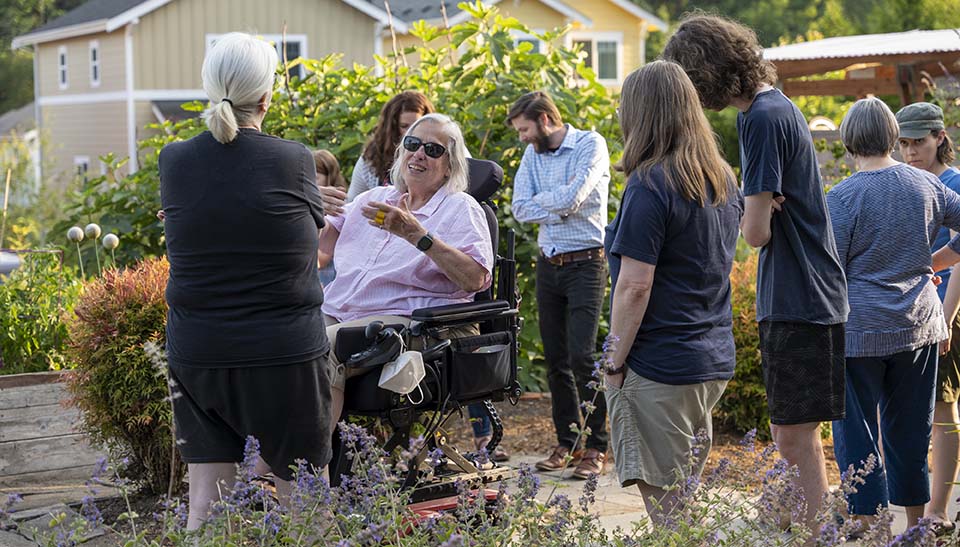
At Finch Green, HRB will create a neighborhood where people of all abilities feel a sense of belonging. Seven homes will meet ADA standards, and all 22 will be designed so that people with mobility issues can visit. (Photo: Marsha Cutting and her neighbors in the community garden at HRB’s Ferncliff Village.)
Before moving to her home at HRB’s Ferncliff Village, Marsha Cutting, who uses a wheelchair much of the time, tied a string to the handle on her front door and wrapped the other end around the lid to a jar, which she kept taped to the wall. Since her chair did not allow her to get close to the handle, she would use the string to pull it within reach. Given the challenges of this living situation, Marsha was relieved and delighted to purchase one of the two homes at HRB’s Ferncliff Village that meet the Americans with Disabilities Act (ADA) standards. It is a great improvement, but there are imperfections nonetheless, for example a curb that makes it difficult for her to enter her home at the just-right angle for her rear-wheel-drive wheelchair or a two-level patio that required the addition of a ramp. Of course, perfection at the outset would be impossible as no two people have exactly the same needs, and homes inevitably require refinement.
But there was a bigger issue at Ferncliff that HRB did not foresee. Because of the front steps on most of the other homes, Marsha can visit only three of her 39 neighbors.
Survey your own neighborhood. If you have no issues getting around, you might be surprised by the quantity of stairs, let alone rocky paths, high thresholds, and poorly placed curbs. “As developers and designers, it’s our responsibility to learn the perspective of people with mobility issues,” said Marja Williams, an HRB consultant and the project manager for Finch Green. “We have a responsibility to understand all the ways people use and experience spaces.”
HRB’s Finch Green, a community of 22 single-family homes to be built on land donated by Bethany Lutheran Church, will be 100% affordable for income-eligible families. It will also be 100% visitable. Not only will all 22 homes have zero-step front entries, they will also have an accessible bathroom on the ground floor.
Seven of the Finch homes will be accessible, incorporating the specifications and flexibility that make for high-functioning and comfortable living spaces for people with disabilities, such as wider hallways, pocket doors, and kitchens and laundry rooms that can easily be adapted for different needs. But good design benefits all, regardless of ability, with the classic example of a curb ramp that serves not only the wheelchair user, but the child on a bike and parent with a stroller. With two to four bedrooms, the homes at Finch were designed with families in mind, and with enhanced accessibility, they will have special appeal for intergenerational families.
The project benefits from the expertise of Williams, who is working with Building Ohana, a mixed-income intentional community in development in Spokane for people with intellectual and developmental disabilities, their families, and caregivers. But the commitment is also fueled by HRB’s desire to do better with each development, to learn from residents’ lived experience, in all its variety. “Including ADA units has become standard practice for us,” said HRB Executive Director Phedra Elliott, “but Finch Green will be the first time that we consider the accessibility of an entire neighborhood rather than isolated homes, adding another layer of inclusion to what we achieve with affordable housing.”
Our hope is that Finch will extend an architectural welcome to people with mobility impairments and send a broader message of inclusion—something that Ferncliff Village has already done. Neighbors made Marsha a raised garden bed in the community garden that she can reach from her chair.