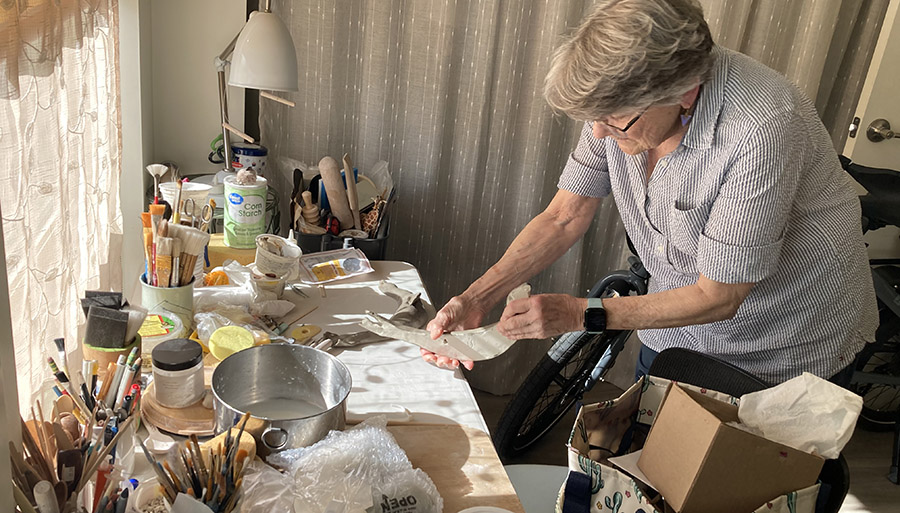
Income qualification for affordable housing happens at the intersection of red tape and real life, where contract compliance can mean low-income earners who need affordable housing are denied. HRB at the Oliver offered a rare opportunity to make affordable housing accessible to more people and meet the needs of an underserved population. (Photo: An HRB resident at the Oliver, an artist, has created a studio in her apartment.)
In October 2025, HRB approached the city with a request to raise the income limits for seven of its thirteen apartments at the Oliver from a maximum of 60% area median income (AMI), or $52,260 for a one-person household, to 80%, or $69,650. All thirteen apartments had already been rented to households below 60% AMI, but this higher cap would allow HRB to expand opportunity at this income band, which at the time accounted for just 4% of the island’s income-restricted affordable rentals.
The city agreed.
In 2024, HRB purchased thirteen one-bedroom apartments at the Oliver with funding from the county, city, and community members and partnership with the developer, Blue North Property Group, which sold them at its cost to build. With the exception of private donations, each funding source came with its own income restrictions. County funding required that four apartments serve households at 60% AMI and below and two serve households at 50% and below. The remaining seven were up to the city to decide so long as they served low-income households.
The Oliver presented an unusual opportunity. Unlike HRB’s more recent developments and acquisitions, the project did not involve state funding, which would have kept all the units at 50% and below. And for the first time, there was funding from the city which was not beholden to the lower state and county income restrictions.
When HRB began leasing the units at the Oliver, there were 149 households on its waitlist seeking a one-bedroom home, of which 92% met the 60% AMI income qualification at first glance. Ultimately, we filled all 13 homes at this income band. However, we often receive applications from people whose base pay would make them eligible to live at the Oliver, but whose overtime pay and premium pay for less desirable shifts might place them just over income in some years. Now we have a place for them too.
This spring there will be a little extra joy at the Oliver. A resident is getting married and moving in with their new spouse. HRB will fill the vacancy with the next person on our waitlist who may earn under 60% AMI or as much as 80%.* Either way—welcome!
*Per HRB policy and some of our government contracts, homeless households and those fleeing domestic violence receive priority.