
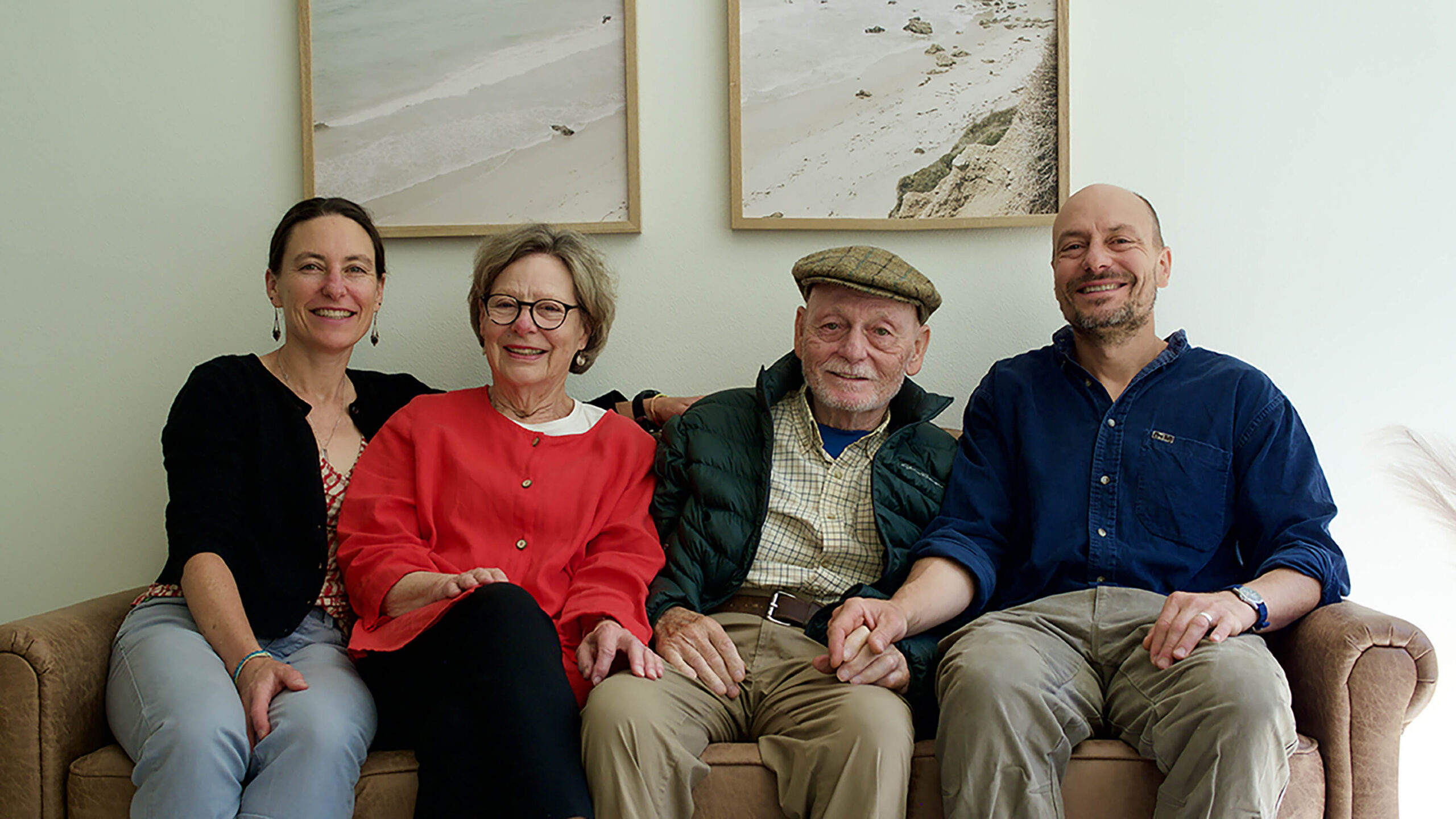
In appreciation of Ed Kushner (1941 – 2026), an HRB founding board member. [Photo, left to right: Siri, Karen, Ed, and Peter Kushner, July 2026]
On September 6, 2026, Housing Resources Bainbridge lost a founding board member, Ed Kushner. If you were not aware of Ed’s role in bringing our organization to life or knew his name only as a fellow islander, you would be forgiven. That’s just as he intended. At times, it has been hard to honor his wishes, to refrain from sharing the scale and specificity of his contributions when we feel such gratitude. But we will exercise that restraint even here, sticking to the facts of our founding and a tribute to his character.
The early days and the founding of HRB
Ed and his wife, Karen, moved to Bainbridge in 1974 and soon made communities of friends and a place of faith at Bethany Lutheran Church. Deep multigenerational friendships formed, carrying Bainbridge history into the present. An old-time island real estate broker took Ed under his wing and set out with him to drive every road, tell all the stories and historical tidbits, and introduce Ed to every possible name and face. It was love at first sight, and Ed’s abiding interest in and care for the lives of individual people found a home in a community which had opened its doors to him.
Ed recalls the Bainbridge of 50 years ago, a place where people of limited means could live a good life and find home in a small community that spawned enduring friendships. But increasingly, he and others took note of trends in steadily rising housing costs and the impacts on islanders living on the edge, outpriced, or excluded. Without access to housing, however modest, doors to the community closed.
In the 1980s, unhoused folks would settle in the woods around Helpline House, a temporary place to call home. Karen, who volunteered at Helpline, and Ed got to know some of them. Helpline knew it had to act, but because housing was not an area of focus for the organization, it formed a separate committee with Ed and other concerned citizens such as future mayor Janet West and Helpline Executive Director Joan Holcomb. At first the committee tried to acquire existing homes but quickly determined that the high price of real estate made that approach impractical. Along the way, additional supporters and donors joined the cause, and in 1989, Housing Resources Board, as it was known then, was founded.
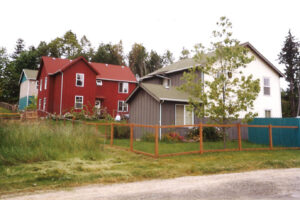 HRB purchased land from Winslow Cohousing, located just behind Helpline, and secured additional funding from the McKinney–Vento Homeless Assistance Act, the first major federal legislative response to homelessness, signed in 1987 and still in existence today. HRB’s inaugural building, Island Home, was completed in 1992 as two-year transitional housing with financial and career education provided by Helpline House. Today the cluster of five duplexes, still fresh from a 2025 rehab, provide permanent housing specifically for families with children.
From compassion to action
Penny Lamping, who retired from HRB in 2020 after 25 years of service on its board and staff, was Ed’s dear friend since the days of raising their children together. For a time, Penny ran HRB’s former HomeShare Program, which found rooms in private homes for people looking for an affordable place to live. “I had a conversation with him about how hard it was to find housing for one person, hours and hours of work by multiple people to find housing for a single person. How can this be? This is just a drop in the bucket. How is this going to help? And he looked at me very sternly, I remember, and he said, ‘But you helped that one person.’ I thought about that every day when I was at HRB.”
Ed lived his life intimately. The stories of individuals resonated with him deeply, be it the hardships endured by an unhoused veteran, a young family priced out of the local housing market, the uncertainty faced by tenants at the Islander Mobile Home Park when it went up for sale, or the death of his longtime friend and civic activist Marge Williams. But what made Ed extraordinary was not just this receptiveness, but the way he connected the stories he heard and the faces he came to know to discern repeating patterns and systemic deficits, and ultimately, to arrive at lasting solutions and act on them.
HRB and Island Home are a testament to that sensibility. But Ed, who had a career in real estate, also helped organize the residents at the mobile home park into a cooperative, mediating discussions among the stakeholders and arranging financing so that they could purchase the park and convert it to homeownership.
The Marge Williams Center is also part of his legacy. Just days after the memorial for Marge, Karen recalled recently, Ed sprung from the bathroom, his face half covered with shaving cream, to share an idea for honoring his friend that was so exciting and so fitting it could not wait for the other cheek. “I know what we have to do,” he said. The community could buy and restore her property and turn it into a center for island nonprofits. As an active community member himself, he understood the practical needs of nonprofits, and today, a quarter century later, the center provides an affordable home to nine nonprofits, having launched many more in its 25 years that went on to purchase buildings of their own.
Still here
In the years since stepping off the board, Ed watched from a distance and with satisfaction as HRB grew. His greatest source of frustration was inaction, and he was comforted by the direction HRB had taken and the scale at which it worked.
This month, the month of Ed’s death, HRB breaks ground at Finch Green, a neighborhood of permanently affordable single-family homes on land donated by his longtime church, Bethany Lutheran, where he had shaped early conversations on how the congregation might use a portion of excess land it had been gifted for its new sanctuary. In a place where, Ed once said, it takes “a bucket full of money” to live, where school enrollment figures keep falling and essential workers who live off island cannot make it here to do their jobs during a power outage or snowstorm, he urged us to think about what it will take to make this community self-sustaining and balanced, a place for the old and young and all types. Finch Green will do just that.
At fundraisers, parties, and community events, HRB staff were known to scan the crowd looking for Ed, as there could be no greater affirmation that the event was worth doing than his presence. “Ed’s here,” we would say to one another. Ed is still here, as the quiet guide he was during HRB’s 37 years, embodying integrity, ethical action, and scrappy community organizing. We’ll look for him about this time next year when we celebrate the completion of Finch Green. We’ll find his legacy flourishing in the new homes and in one another. “Ed’s here.”
The Ed’s Housing Community Fund has been established at both HRB and the Bainbridge Community Foundation (BCF) to honor and advance Ed’s work in affordable housing. To give via HRB, follow this link and note “Ed’s Housing Community Fund” in the last field asking why you give to HRB. To give via BCF, click here.