
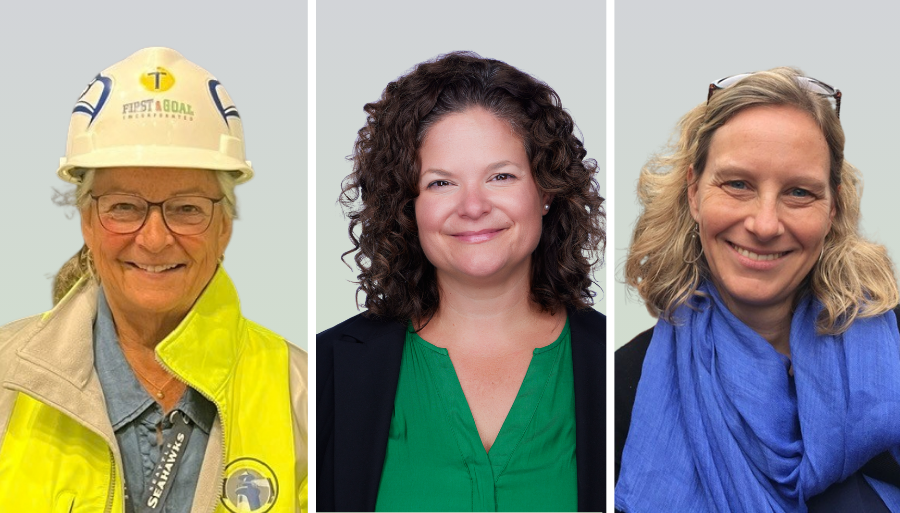
The three women developing Finch Green reflect on the project, the process—and one another. [Photo, left to right: Tina Gilbert, Phedra Elliott,
In the US, women represent just 11% of the construction workforce and fill 2.8% of C-suite executive positions in commercial real estate, a gender gap that has proven especially durable relative to other industries. But the numbers look different at Finch Green. Here the development team is 100% women:
Tina Gilbert, a four-time former HRB board member and the owner of OTWB Inc., is the owner’s representative and construction manager. Her role is to ensure that the project team completes the project on time and within budget while protecting the interests of HRB and Bethany Lutheran Church, which donated the land and abuts the project. Tina has offered her services pro bono to HRB since 2019.
Marja Williams, owner of Urban Oranje, serves as development consultant for Finch Green, coordinating the partnership with Bethany Lutheran Church, leading the predevelopment team, overseeing the project budget, and working closely with the HRB team to manage funding throughout the project.
Phedra Elliott, HRB’s executive director and the project developer, has a hand in everything, from forging the partnership with Bethany Lutheran Church, fundraising and financing, to value engineering and final decision-making.
They’ve got different styles and different stories, and they’ve come together to form a team whose success is grounded in communication, respect, and shared passion for affordable housing.
Tina found her calling in construction as a young woman in the 1970s. To help pay for college, she became a carpenter’s apprentice, knowing nothing about the trade but inspired by her father’s career in architecture, her mother’s gumption, and most of all, a powerful and liberating curiosity that made it easy to shrug off gender roles. After graduation, she convinced Turner Construction, an international firm headquartered in New York City, to take her on for a six-month trial despite her inexperience. “It worked out for 20 years,” said Tina, who went to become the firm’s first woman superintendent, first woman project engineer, and first woman project manager. Today she’s got her own business and a list of credits that includes IslandWood, Olympic Sculpture Park, extensive work at Seattle University, and now Lumen Field, where she’s the logistics coordinator and in that role, assisted the team in the transformation of the stadium for last summer’s World Cup.
After retiring from a career as a planner for the city of Bainbridge Island, Marja was asked to help with the development of BIMA, specifically permitting and a community engagement process fraught with pushback. The work was rewarding. Marja stayed with the team and went on to develop Grow Community and The Walk, also on Bainbridge Island. Ten years ago, she returned to school for an MBA so she could better understand the finance controlling so many of the decisions about how communities are built.
Phedra began her professional life with a short-lived career in elementary school education, followed by ten years in human resources, then federal grants administration for the city of Bremerton, where she was first introduced to community land trusts, a model that immediately captivated her and set her sights on HRB. Phedra started at HRB in 2010 and assumed the role of executive director in 2016, when her focus was on building infrastructure and a “mature” organization. With staffing solid and land for the Ericksen Community secured in 2019, Phedra stepped into the role of developer and has led the organization into an unprecedented period of productivity.
All three women are reticent about making generalizations about gender and acknowledge the men who have mentored them along the way, but each can vividly recall being in a project or task force meeting with all or mostly men, and it wasn’t always a comfortable fit. Tina once attended a 20-person contractor meeting as the project manager and the only woman when she was asked if she would be taking notes. (The men that asked, assuming she was a project administrator, later apologized.)
All three appreciate the easy relationships established within the Finch development team and respect for one other’s expertise. “It’s less about posturing and trying to be right than it is about trying to figure it out and work together,” said Phedra. In this environment, she’s not shy about saying when she doesn’t know something. “It doesn’t behoove me to pretend to know something when I don’t. That’s not good for the organization.”
“I know a little bit about a lot of things, but [the tradespeople] know a lot about one thing, like a drywaller or a plumber,” said Tina, who professes a “curious nature, maybe to a fault.” She sees every encounter as an opportunity to learn and can’t pass by someone doing their job without asking about project details and techniques. With Finch, she credits Marja for her deft management of the finances and Phedra for her calm and patience in working through administrative challenges, like the intricacies of HOA rules. “I also treat everybody like I want to be treated so we’re all equals. I might be the project manager but we’re all at the same level working together as a team. There’s no real hierarchy.”
“I think this particular team is really collaborative. I think they’re focused on trying to create the best outcome not just for the project in terms of finances and technical design, but for building places that will make people’s lives better,” said Marja.
Ultimately, it’s the passion for affordable housing and a shared vision of just how wonderful Finch Green can and will be that unifies and energizes the team. The details of this project, notably the focus on building community by clustering the houses around shared greenspaces and including select accessibility features in every home so that residents of all abilities can visit, get Tina rhapsodizing. “A neighborhood with people of all ages out in the common, kids on trikes and bikes, playing with toys and interacting with a grandmother that they might not have in their own life or young mother interacting with a neighbor… I see it as a real neighborhood which is spectacular.”
“I wouldn’t be here on Bainbridge Island in this community doing this work if I hadn’t had the opportunity to buy a house at a very affordable price 12 years ago and raise my children in a place where they were safe and supported in community,” said Marja. “And so this project means a lot to me because I want to pay that forward.”
“It does feel great to be closing this chapter that’s been many years long since HRB and Bethany Lutheran Church first began talking about how this land might be used for affordable housing, to be creating this place on this land for more people to be a part of this community and to have the benefit of homeownership if that’s what they want,” said Phedra.
Of course, the work of Finch Green extends well beyond the development team, drawing on the vision of architect Jonathan Davis, the know-how of Paul Lyman, owner of High Country Contractors Inc., and the generosity of the congregants at Bethany Lutheran Church who first dreamt this project and later donated the land to HRB.
“When we can bring teams together where we have different perspectives, then I think we can create better spaces,” said Marja. Women, men, and people of all kinds have come together to create Finch Green, a very special space on Bainbridge Island. Families are expected to move in early 2028. They’ll develop the community.